Claude can analyse finance.
Arfiti lets it operate finance.
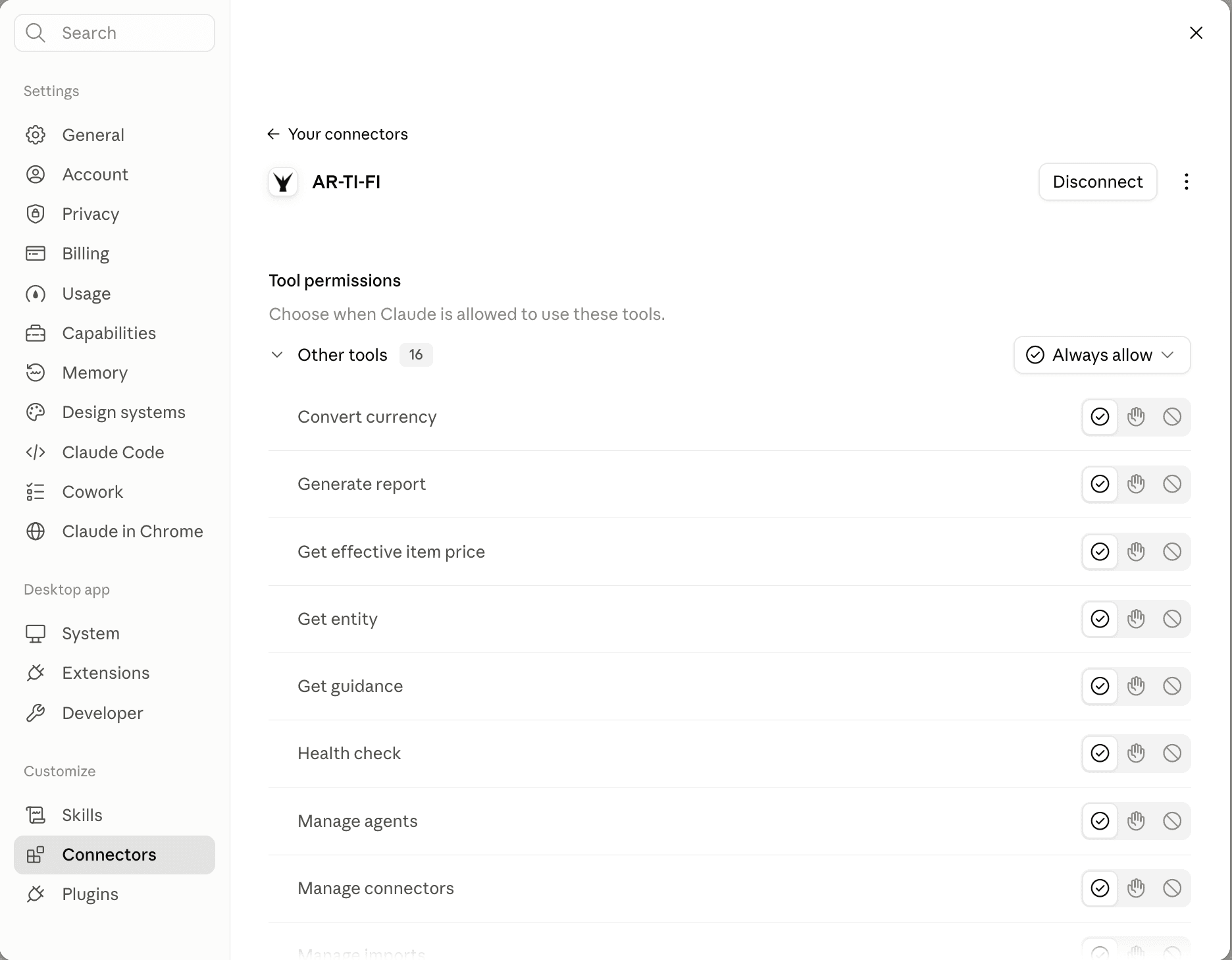
Connect Claude to Arfiti and it works with your live financial records, your procedures and your approval rules. Ask for a report, post a bill, run the close, or hand the repeating work to an agent, all through the same controls your team uses.
Arfiti is an independent company and is not affiliated with or endorsed by Anthropic.
- Works in
- Claude.ai and Cowork; other clients depend on their MCP and plugin support
- Connection
- One MCP connector · 17 tools · a permission per tool
- Runs
- Interactive, scheduled, event-driven
- Approvals
- Your workflow lanes, per operation
- Record
- Double-entry ledger, attributed audit trail
It starts as a connector in Claude.
Arfiti is an MCP server. In Claude it appears as a connector with its finance tools listed, and you decide per tool whether Claude may use it freely, must ask first, or is blocked. The same server connects Claude Desktop, Claude Code, Cowork and other MCP clients, and every call carries the identity and entity scope of the person behind it.
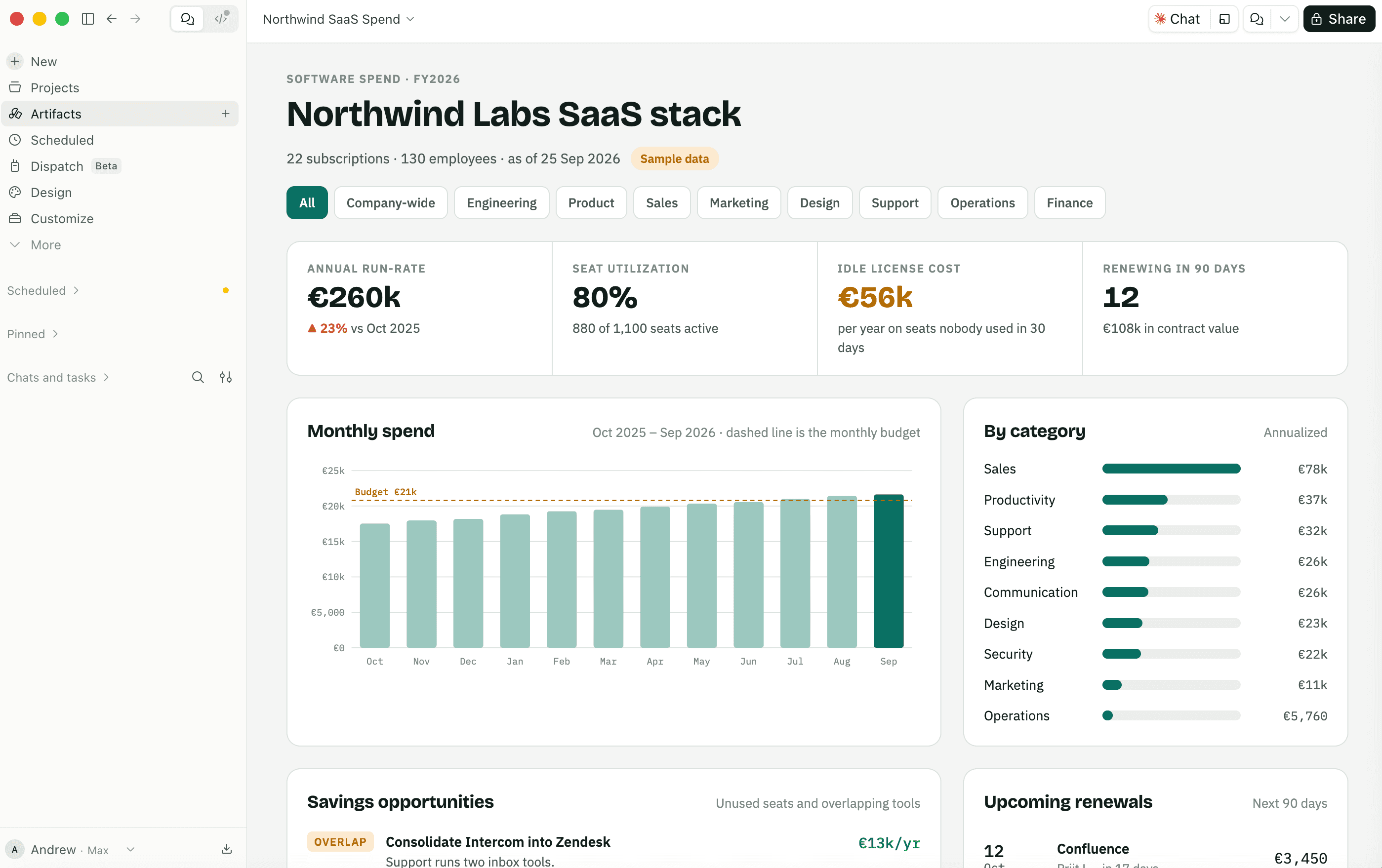
Ask for the view. Keep the Artifact.
With the ledger connected, Claude answers from your postings rather than from files you paste in. Ask for spend by category, an aging, a variance against plan, and it can build the report as a Claude Artifact you keep, refine and return to. The numbers come from the same records your accountant closes on, scoped to the entities you are allowed to see.
Turn a decision into a controlled action.
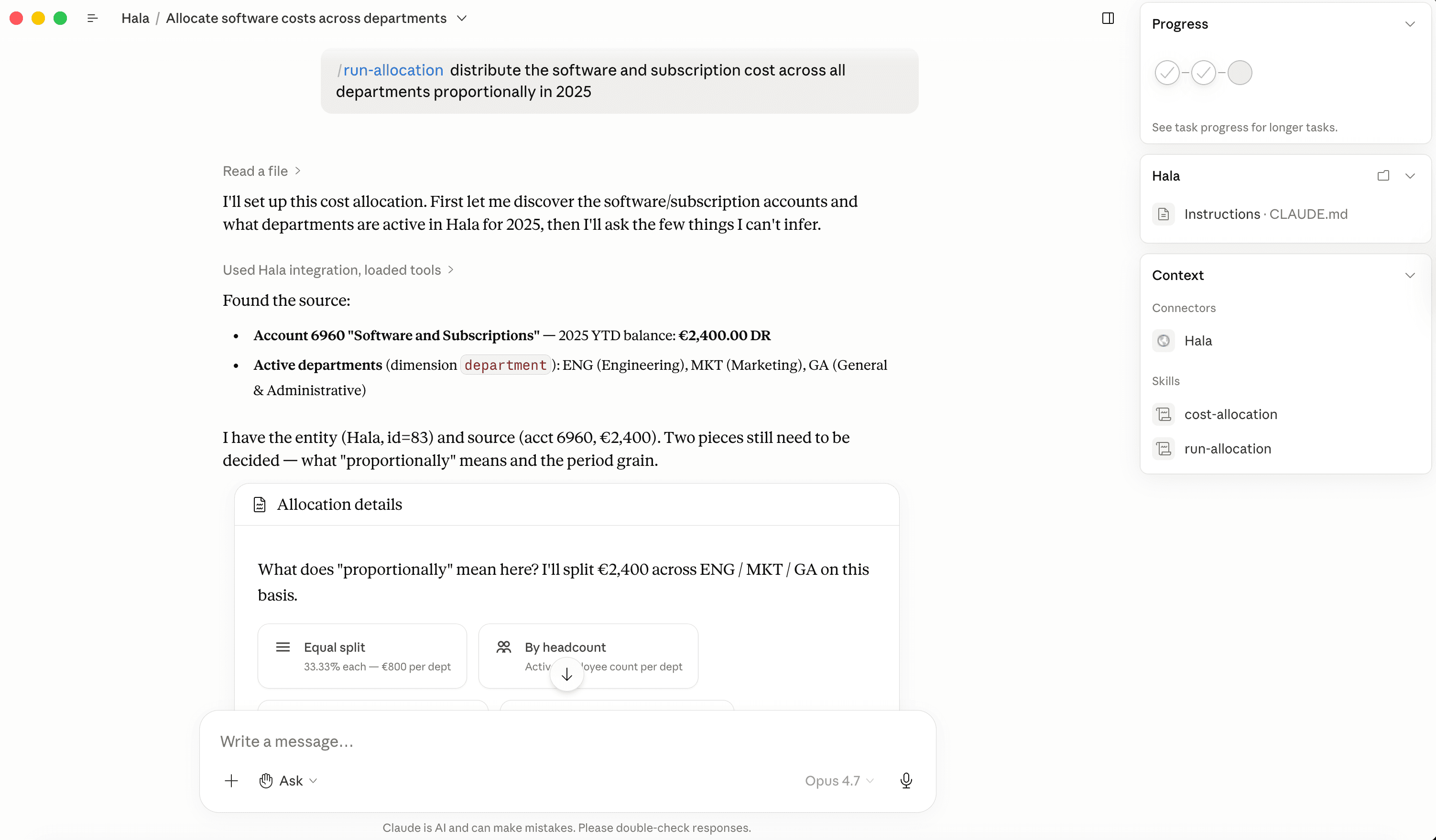
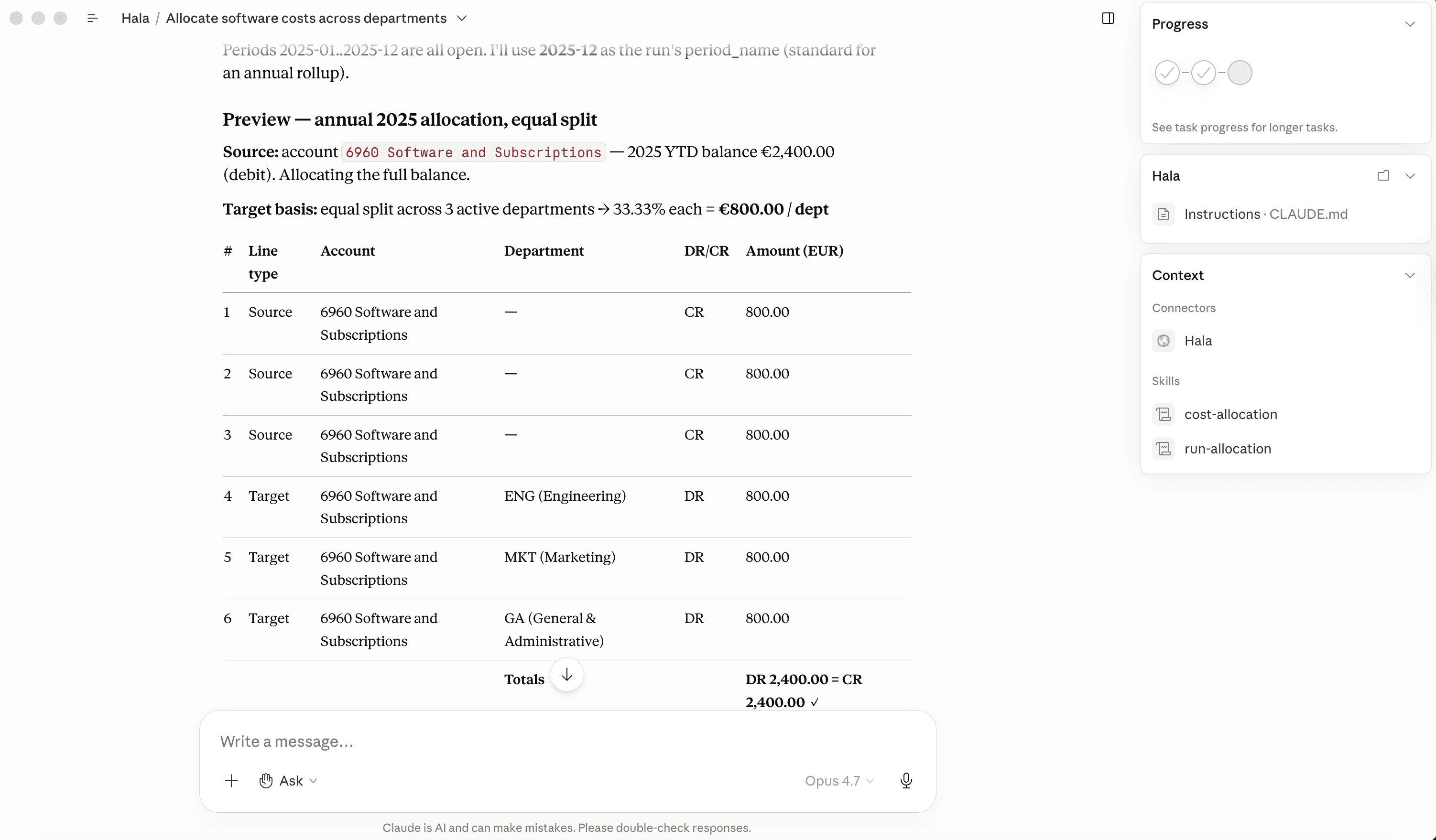
Say what should happen and Claude prepares it: it reads the accounts involved, asks the one question it cannot answer itself, and shows the proposed entries before anything is written. The submission goes through the same workflow definition a person would use, so the risk lane, the approver and the audit row are the organisation's, not the model's. Low-risk work runs through. Anything unusual waits for the reviewer your policy names.
Run it repeatedly, under the same rules.
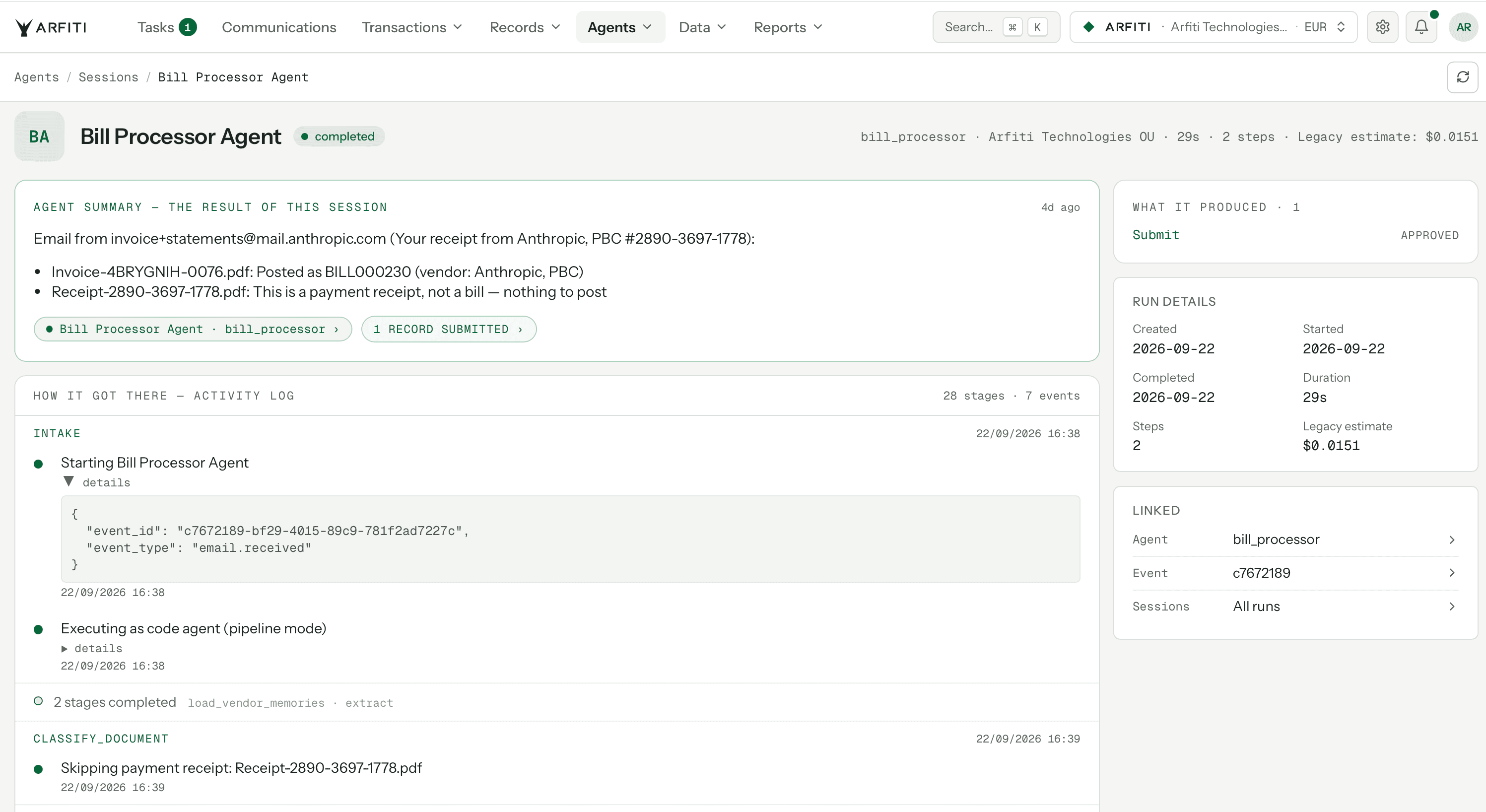
Work that repeats does not need a person in the chat. Arfiti agents run the same logic on a schedule or when something arrives: an emailed bill, a bank line, a billing date. Each run is a session you can open: what it read, what it decided, what it submitted, what it left for a person, with duration and model cost on the record. What an agent cannot resolve becomes a task for the right person, and you can answer it from Claude.
Your procedures, as plugins and skills for Claude.
A plugin packages a procedure for Claude: slash commands, the skill that explains the steps, and the connection to Arfiti. The engine stays in Arfiti; the plugin carries how your team does it. The plugin catalog covers shared finance procedures and scoped Estonia packs, from financial reports and budget planning to the VAT declaration and the annual report. Skills are versioned documents your team writes in plain language. Instructions do not grant extra permissions or bypass applicable controls.
Beside your ERP, or as the ERP.
Claude and the agents work the same way in each mode. What changes is which system keeps the ledger.
Evaluate a workflow alongside your existing ERP. Agree connector coverage and the system of record before relying on an integration.
Move selected workflows to Arfiti. Run chosen processes through Arfiti while reconciling the controlled result with the existing environment.
Run finance on Arfiti. Arfiti is the financial system, the operational layer and the ledger; the dashboard is for configuration and review.
Analysis versus operation
| Dimension | Claude as an analysis tool | Claude operating through Arfiti |
|---|---|---|
| Context | Files you paste into the conversation | Governed access to live financial records |
| Instructions | Prompts rewritten for each task | Versioned skills and reusable plugins |
| Output | Analysis and recommendations | Controlled actions and financial records |
| Execution | You start every interaction | Interactive, scheduled or event-driven |
| Controls | Review happens outside the chat | Permissions, approval routes, evidence |
| Record | Stays in the chat or a file | Traceable to a workflow and a ledger entry |
Claude remains the intelligence and the interface. Arfiti is the operating environment beneath it: the tools, the rules and the record.
Questions finance teams ask
Is Arfiti part of Anthropic?
No. Arfiti is an independent company. It connects to Claude through the Model Context Protocol, the open standard Claude uses for connectors.
Does Claude post directly to the ledger?
No. Claude submits a proposal through the same workflow gateway a person uses. The workflow's risk lane decides whether it executes immediately or waits for an approver, and the database refuses anything unbalanced, dated into a closed period, or rewriting posted history.
Do we have to use Claude?
No. You can also use compatible MCP clients such as Codex. Client setup and support for skills or plugins differ; see the separate ChatGPT connection guide.
Can we use Arfiti without replacing our ERP?
You can evaluate a workflow alongside your existing system. Connection coverage and the system of record must be agreed for your setup; do not assume a ready-made connector for every ERP.
Can Arfiti be the primary financial system?
Yes. In Native mode Arfiti is the ledger, with double-entry accounting, periods, entities, currencies and an attributed audit trail.
Who can write plugins and skills?
Anyone on your team, a partner, or us. A plugin is a package of commands and skills pointed at your Arfiti organisation. Plugins cannot change permissions or bypass the controls.
What is the difference between asking Claude and running an agent?
The same tools and rules. Asking Claude is interactive, with you in the conversation. An agent runs the same logic on a schedule or an event, with its own role and scope, and leaves a session you can open.
How are approvals and evidence handled?
By the workflow definitions your organisation owns: who may approve, from which amount, in which order. Every submission, approval and posting leaves an attributed record you can query from Claude.
See Claude run one of your processes.
Bring one real workflow. In a working session we connect Claude to a demo ledger and run it end to end, with your approvers and your thresholds.