Accounts receivable in ChatGPT: find what needs a follow-up
Turn an accounts receivable list into specific next actions: confirm the remaining balance, inspect payments and credits, then prepare a follow-up for review.
A customer appears on the overdue list, but their finance team says they paid last week. Before sending another reminder, someone needs to inspect the invoice, the receipt, any credit notes and the way the payment was applied.
The ChatGPT Accounting plugin can help work through that evidence. With a suitable connection, the conversation can use open-invoice records and supporting transactions to prepare a more accurate next action. Arfiti supplies the accounting records and supported operations in the workflow described here.
We reviewed a prepared synthetic customer case in ChatGPT with Accounting selected and Arfiti connected: a $1,200 invoice, a $700 receipt and a $100 applied credit. The saved invoice has $400 remaining. ChatGPT traced those applications and retrieved a certified aging report showing the same $400 outstanding, tied to the receivables control balance.
Check the invoice balance against the aging report
With Accounting selected and Arfiti QA US connected, we asked:
Recheck INV000019 and the AR aging as of 22 November.
The synthetic case uses Atlas Labs QA and invoice INV000019. Its saved records show receipt RCV000016 for $700 and credit CRM000003 for $100 applied against the $1,200 invoice.
The result showed $400 remaining, with $400 in the 1–30 days overdue bucket and zero in the other aging buckets. The invoice was due on 21 November, making it one day overdue at the requested 22 November reporting date.
| Check | Result as of 22 November 2026 |
|---|---|
| Invoice amount remaining | $400 USD |
| Certified AR aging total | $400 USD |
| Receivables GL control balance | $400 USD |
| Control difference | $0 USD |
| Certification exceptions | 0 |
The screenshot below shows the aging and control check.
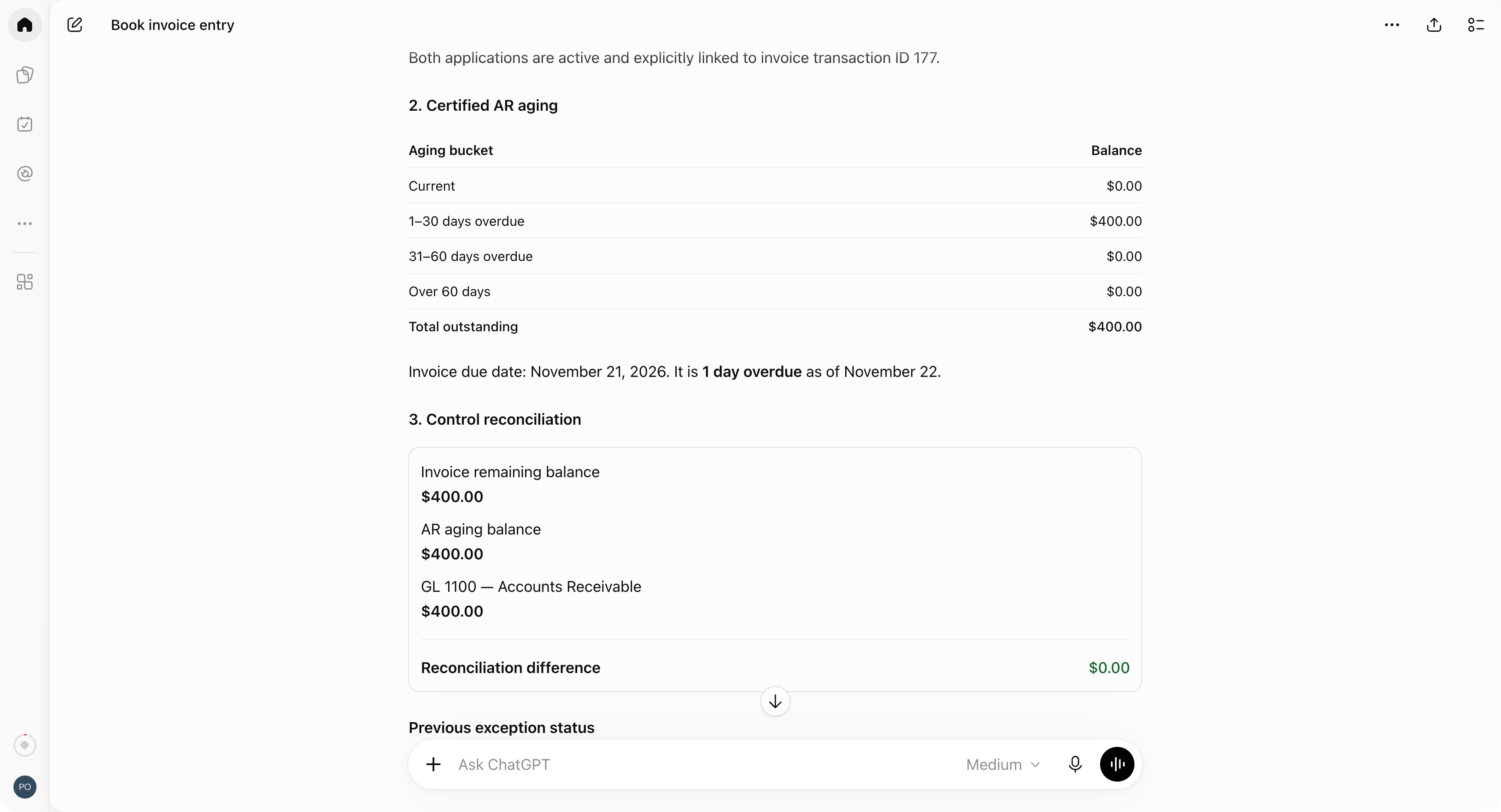
This is a useful review result: the person can follow the original amount through the cash payment and credit, then check the remainder against a dated report. The report still flagged an unconfirmed default reporting timezone. Confirm that setting for your company, particularly when reviewing activity near a date boundary.
These are synthetic, noncollectible demonstration records. The ChatGPT review changed no records and sent no reminder. The result applies to the selected entity and reporting date; a different date requires its own report.
Start with a question that leads to a decision
“Show receivables” can produce a large table without telling the team where to begin. A more useful first question is:
Which customers need a follow-up today?
The answer needs a reporting date, legal entity and currency basis. It should identify invoices with an amount still due and explain whether they are overdue under their recorded terms. A future-due invoice may matter for cash planning, but it should not be presented as late.
For a team review, ask for invoice-level evidence behind customer totals. The output should let you connect each recommendation to a due date, an outstanding amount and a source record. If the system has incomplete settlement history, that limitation belongs in the answer rather than being hidden behind a precise-looking aging bucket.
A priority list also reflects policy. A small old invoice might need more attention than a large invoice due yesterday. Contract disputes, customer promises and relationship considerations can change the order. Ask the assistant to propose a list and state its basis; let the team decide the collection approach.
What Accounting contributes
OpenAI describes the Accounting plugin as assistance for bookkeeping, reporting and audit work grounded in records. Its skill instructs ChatGPT to investigate partial or grouped payments, credits, reversals and other plausible explanations when reconciling transactions.
Those instructions are useful for receivables because an invoice's original amount and its collectible balance can differ. A status label alone cannot explain that difference. The assistant needs the underlying amounts and relationships.
The plugin and connection have different responsibilities. Accounting supplies task guidance. The connected system determines which records can be read and which actions can be taken. Availability depends on the connection and the user's access; installing a plugin does not create permission to change customer accounts. See OpenAI's connected-app guidance for that distinction.
Review the remaining balance before drafting a reminder
The actual synthetic invoice and its applied records contain:
| Item | Amount |
|---|---|
| INV000019 · original invoice | $1,200 |
| RCV000016 · payment applied | $700 |
| CRM000003 · credit applied | $100 |
| Remaining amount due | $400 |
The arithmetic is $1,200 − $700 − $100 = $400. A reminder for $1,200 would ignore both the payment and the credit.
Ask:
Show what makes up this customer's balance.
A useful response should show the invoice and the applied items that reduce it. Confirm that the payment and credit are actually applied to the relevant invoice. A credit note merely present on the account may not yet reduce that specific invoice's recorded amount due. Likewise, an unapplied receipt should be investigated before assuming that the customer still needs to pay.
The example uses USD and saved applications. Its invoice header records $800 against the original amount, comprising $700 cash plus $100 credit; that field must not be described as $800 received in cash. Foreign-currency receipts, deductions and disputed credits require additional evidence. The assistant should explain those cases rather than forcing them into this simple subtraction.
Investigate “we already paid”
The customer may have sent one payment covering several invoices. They may have paid from another legal entity, used an unexpected reference or deducted a disputed charge. The receipt could also have arrived after the report's cutoff.
Follow up with:
Check whether their payment has arrived.
The answer should identify what was searched and which records support a candidate match. A matching amount is a starting point, not proof. Compare the payer, reference, date, currency and remittance details. For a grouped payment, show the proposed allocation across invoices and verify that the total allocation does not exceed the payment available.
If evidence is missing, the next action may be to request a remittance advice or ask the cash-application owner to investigate. This gives the collections team a concrete reason to pause the reminder. It also avoids making a customer repeat information that is already present elsewhere in the records.
Applying a receipt is an accounting action. Any proposed application must use the connected system's supported workflow and required authorization. Do not describe an identified candidate as a completed application.
Prepare a message that matches the evidence
Once the balance and context have been checked, ask:
Draft a polite follow-up for the remaining $400.
A useful draft identifies the invoice, the remaining amount and the due date. If the payment and credit are confirmed, it can acknowledge them. It should avoid claims about overdue days, penalties or promised payment dates unless the supporting records establish those facts.
The reviewer should check the recipient and tone as well as the numbers. A routine reminder, a dispute response and a final escalation are different communications. The assistant should not invent a company collections policy or make concessions on the team's behalf.
Preparing a draft is separate from sending it. A suggested next step is a reviewable message, once the accountant has checked the balance and collection context. That draft has not been demonstrated in this take. No customer contact is necessary to assess whether the workflow is useful, and this article does not claim that any message has been sent.
Keep current balances and historical aging distinct
“What is owed now?” and “What was owed at month-end?” are different questions. A payment received this week can change today's balance while leaving the earlier reporting date's balance unchanged.
For a historical question, ask explicitly:
What was outstanding at 31 October?
The answer needs reliable dated settlement evidence. Current payment counters cannot by themselves reconstruct every prior balance. Arfiti's report guidance treats unavailable historical evidence as a limitation to disclose. An assistant should not silently substitute current values into an earlier aging report.
This distinction matters when explaining why a collections list differs from a month-end pack. The difference may reflect timing rather than an error. Comparing the two scopes and showing the intervening applications gives the reviewer a way to check that conclusion.
Finish with owners and next actions
A useful review ends with a small set of actions tied to evidence: send an approved reminder, request a remittance, investigate an unapplied receipt, resolve a disputed credit or monitor an agreed payment date.
Ask the assistant to preserve the source references with each action. That makes it easier for another team member to continue the work and to rerun the review after the records change. A prepared message or an assigned action is progress; cash collection is a separate outcome that must be verified.
To try this approach, request access to Arfiti with one receivables case you want to investigate. The Arfiti for ChatGPT guide explains the connection approach. Start with a small synthetic or approved sample before expanding the review to your live customer book.