Use ChatGPT Accounting to prepare a reviewable accrual
An accrual is easier to review when the service evidence, estimate and existing entries sit beside the proposed journal.
The invoice is missing. The service was delivered. Your close workbook has last month's estimate, a manager's email and an empty journal reference. Before you can finish the accrual, you need to establish what belongs in this month and whether someone has already recorded it.
That is a useful job for ChatGPT Accounting: organize the evidence around a proposed entry so the accountant can review the amount and its basis together. The benefit is practical. You can spend the review discussing the estimate instead of reconstructing how the preparer reached it.
We tested that preparation in ChatGPT with the Accounting plugin selected and Arfiti's synthetic US company connected. An invented support agreement, delivery confirmation and scoped policy supported an $800 proposal. ChatGPT checked the live demonstration records for duplicates and prepared a balanced journal in the conversation. The expense classification remained provisional; no journal was submitted or posted.
What the Accounting plugin contributes
OpenAI's Accounting plugin provides guidance for accounting work in files and connected software. Its public examples include examining close workbooks and grounding explanations in records. Access to a particular company's ledger depends on the connected app and its permissions.
For an accrual, the useful combination is source interpretation and arithmetic. A contract describes the commercial arrangement. A service confirmation helps establish what happened. The ledger shows what has already been recognized. A good preparation task connects those pieces and makes any gaps visible.
Arfiti supplies accounting records and governed operations when connected. The Accounting plugin supplies task guidance within ChatGPT. Selecting the plugin does not establish that an accrual has been approved, that a journal tool is available, or that your company has adopted a particular estimation method.
Start with the obligation and the period
Our synthetic source document covered completed support services from 1–20 November 2026, for a fixed $800 USD fee. It named fictional supplier Supportdesk QA and reference QA-SUPPORT-2026-11-A. The delivery confirmation was dated 20 November; no invoice had arrived as of 22 November.
The document also supplied a policy scoped to this example: recognize the completed service cost in November and prepare an expense/accrued-expenses proposal for review. Tax and foreign currency effects were excluded. These are explicit fixture assumptions, not universal treatment for support contracts.
After uploading that document, we asked:
Prepare this support accrual for review. Check for duplicates first.
For your own task, provide the agreement, evidence of delivery and applicable company policy. Identify the entity, reporting currency and cutoff date. The connection must also supply the relevant payable and journal records, or the duplicate investigation remains incomplete.
The missing invoice starts the investigation; it does not settle the accounting. A purchase order might cover future work. An email might confirm only part of a project. A supplier could already have billed through a different description. These possibilities affect the amount before anyone chooses the journal accounts.
Ask ChatGPT to distinguish evidence of the agreed price from evidence of service delivery. A signed contract can support the rate without proving that November's service occurred. That distinction makes the resulting workpaper more useful than a summary of the documents.
Make the estimate reproducible
The source described a fixed fee for the completed service period. The proposal therefore used $800, rather than prorating a monthly subscription or extrapolating a full November charge.
ChatGPT proposed this entry dated 20 November 2026 for US-MAIN:
| Proposed journal line | Debit | Credit |
|---|---|---|
| 6700 · Professional Fees | $800 | — |
| 2100 · Accrued Expenses | — | $800 |
| Total | $800 | $800 |
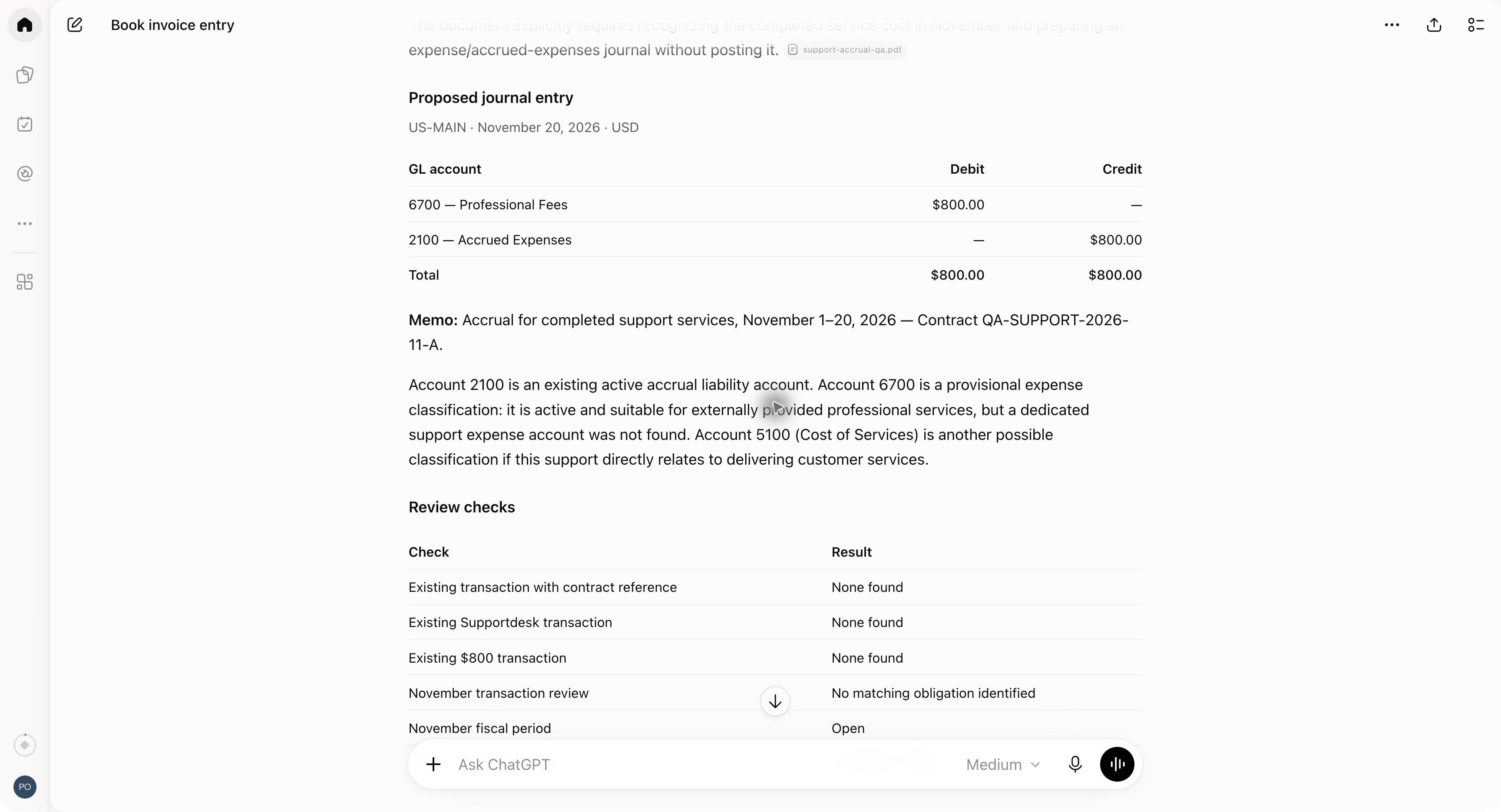
The response identified account 2100 as an existing active accrual liability account. It explicitly marked 6700 as a provisional expense classification. If the service were a direct cost, it identified 5100 as an alternative to review. Those account numbers belong to this demonstration chart; the accountant still needs to confirm what the service represents and where it belongs.
This is a useful review point. A balanced entry can still use the wrong expense category. The available chart and the source description can support a proposal without resolving whether a cost belongs in overhead or direct costs. The next step is classification review, not treating equal debits and credits as approval.
The workpaper should retain the contract reference, service period, fixed fee and policy basis beside the entry. A reviewer can then follow the amount to its source and focus on the unresolved classification.
For a partial period, ask which allocation basis the contract and policy support. Calendar days, working days, hours and milestones can produce different results. ChatGPT should expose that choice rather than quietly treating every month as thirty days.
Check whether some of the expense is already recorded
A supported amount can still duplicate an invoice or earlier accrual. In this test, ChatGPT searched November demonstration records by the source reference, vendor and amount. It reported no matching obligation. The period was open, and the fictional supplier was not found in the live supplier records. No supplier or account was created.
That result describes the records and search scope checked in this session. For a real close, inspect the relevant payable entries, journals and prior accruals for the same entity and service period. References and descriptions may differ. A supplier absent from the master list does not by itself prove that no related expense exists.
A short follow-up for an unresolved case is:
Show any entries that could overlap with this accrual.
If part of the same obligation is already recognized and remains valid, identify that entry before proposing an additional amount. A payment alone does not establish expense recognition. Ask for its accounting effect rather than deducting it from an estimate merely because the amount looks related.
The practical outcome is a proposal with a specific duplicate-check scope and an explicit remaining question about classification. It gives the reviewer more to work with than a journal amount alone.
Separate the proposal from posting
In our test, the response offered a classification review. We stopped at the proposal: no journal was submitted, no posting task was created, and nothing was posted. For a subsequent preparation step, you could ask:
Prepare the journal and its support. Do not post it yet.
The package should identify the entity, accounting date, expense and liability accounts, dimensions where relevant, amount and explanation. Add unresolved items prominently. “Service confirmation missing” belongs beside the proposed amount, not buried below a confident conclusion.
The responsible reviewer decides whether the estimate is supportable under the applicable accounting framework and company policy. Posting, if requested later, depends on the available app action, the user's permissions and the system's controls. A draft in chat is still a draft.
After an authorized posting, read the saved entry back from the accounting system and reconcile it to the approved proposal. If the action's outcome is unclear, check the records before retrying. OpenAI's accounting guidance makes this duplicate-prevention distinction for uncertain entry outcomes.
Plan what happens when the invoice arrives
The work is easier to finish next month if the accrual carries a clear service period and source reference. When the invoice arrives, the accountant can compare the actual charge with the estimate and identify the treatment required by company policy.
Some workflows use a scheduled reversal. Others clear the accrued liability against the invoice. The appropriate approach and date depend on the approved process and available system operations. A prompt should not silently reopen a closed period or choose a correction date merely because it is convenient.
Ask for a follow-up note stating who will review the invoice, how to identify the accrual and what would require further judgment. That note gives the next preparer a concrete starting point.
For your first trial, choose one straightforward service accrual with an accessible contract and an identifiable service owner. Give ChatGPT Accounting the evidence, ask for the proposed journal, and review whether every material figure can be traced. Discuss your close workflow with Arfiti if you want to explore how connected accounting records could support that preparation.