Build a clearer accounting evidence pack with ChatGPT
A posted bill is a starting point. A useful evidence pack explains the source, recorded effect and questions that remain.
An auditor asks for support for a software expense. The invoice is in one place, the journal is in another, and the conversation explaining the coding sits somewhere else. The accountant has to turn those records into a package another person can follow.
ChatGPT Accounting can help organize that preparation. Its useful role is to connect each requested item to available support and identify what is missing. OpenAI describes this evidence-gathering use in its accounting guidance.
We tested that preparation against a recorded Arfiti demonstration: a synthetic $360 supplier invoice, an explicit confirmation and a saved bill. A subsequent read-only evidence check traced the source, completed review task, posted journal and outstanding balance. It found a concrete gap: the original PDF was present in the chat but was not linked to the saved bill. We repaired that link through Arfiti's supported attachment process, then used ChatGPT to retrieve and read the stored invoice.
Start with what the recording actually establishes
In our demonstration, ChatGPT had OpenAI's Accounting plugin selected alongside the Arfiti QA US connection. The source document was a synthetic software invoice for three seats at $120 each. The user asked:
Book this invoice.
The proposed bill waited for confirmation as task 192. The same person then wrote:
Looks good, confirm it.
Arfiti recorded BILL000022 for $360. A subsequent read showed a debit to software expense and a credit to accounts payable, both for $360. The demonstration did not initiate a payment.
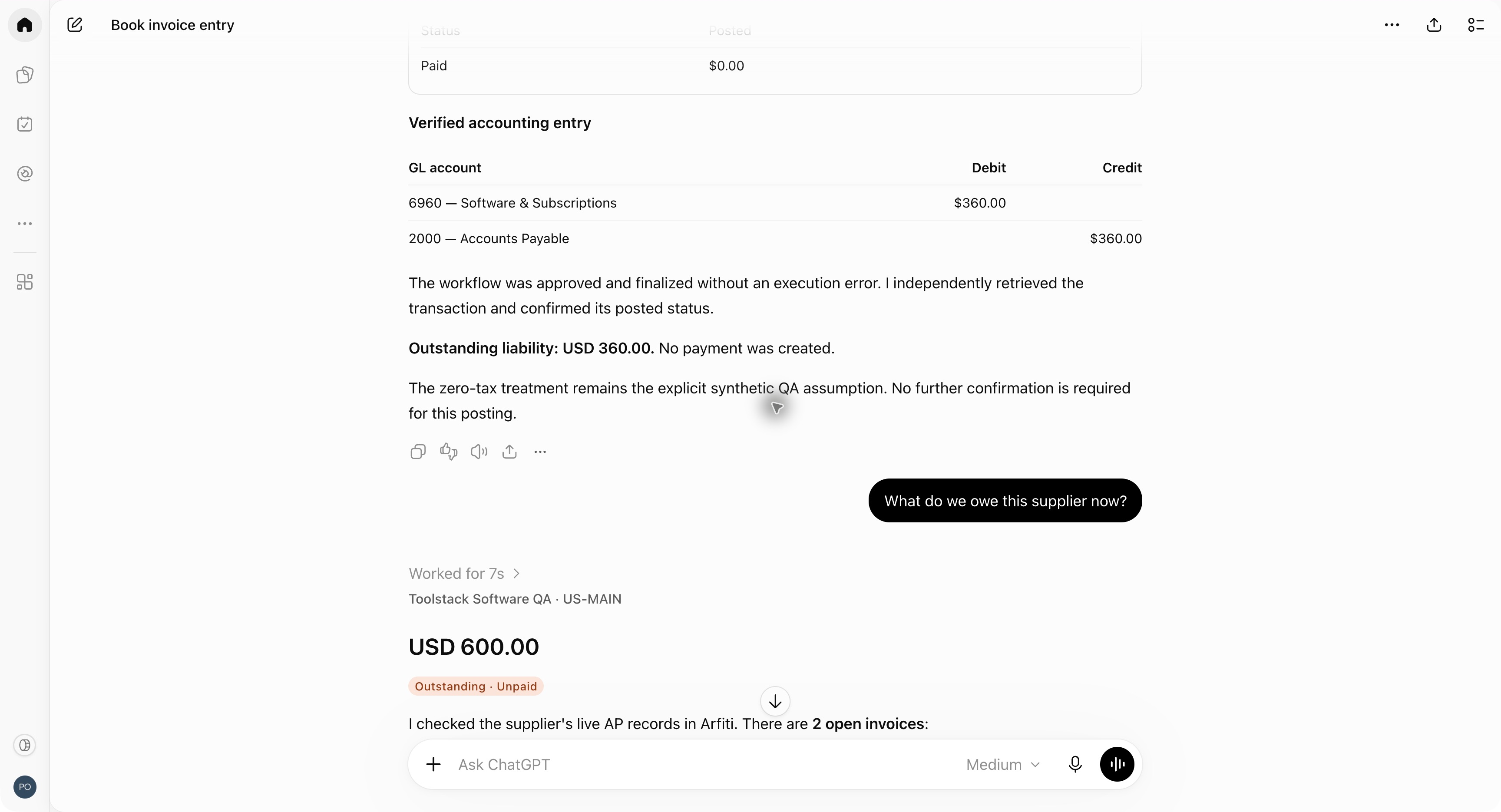
The user then asked what was owed to the supplier. The answer was $600, comprising the new $360 bill and an earlier $240 bill. That detail matters when someone later asks why the supplier balance differs from the invoice under review.
Give each source a clear job
A useful evidence pack explains which question each item helps answer. The invoice supports its stated supplier, description, amount and dates. The posted journal shows how the system recorded the expense and liability. The supplier balance identifies amounts outstanding under the report's scope and cutoff.
These records answer related questions, but they are not interchangeable. A balanced entry does not establish that a service was received. An invoice does not establish that it was paid. A chat message saying “confirmed” needs the saved outcome if the request concerns the accounting effect.
On 22 November 2026, in the same Accounting-selected ChatGPT conversation, we asked:
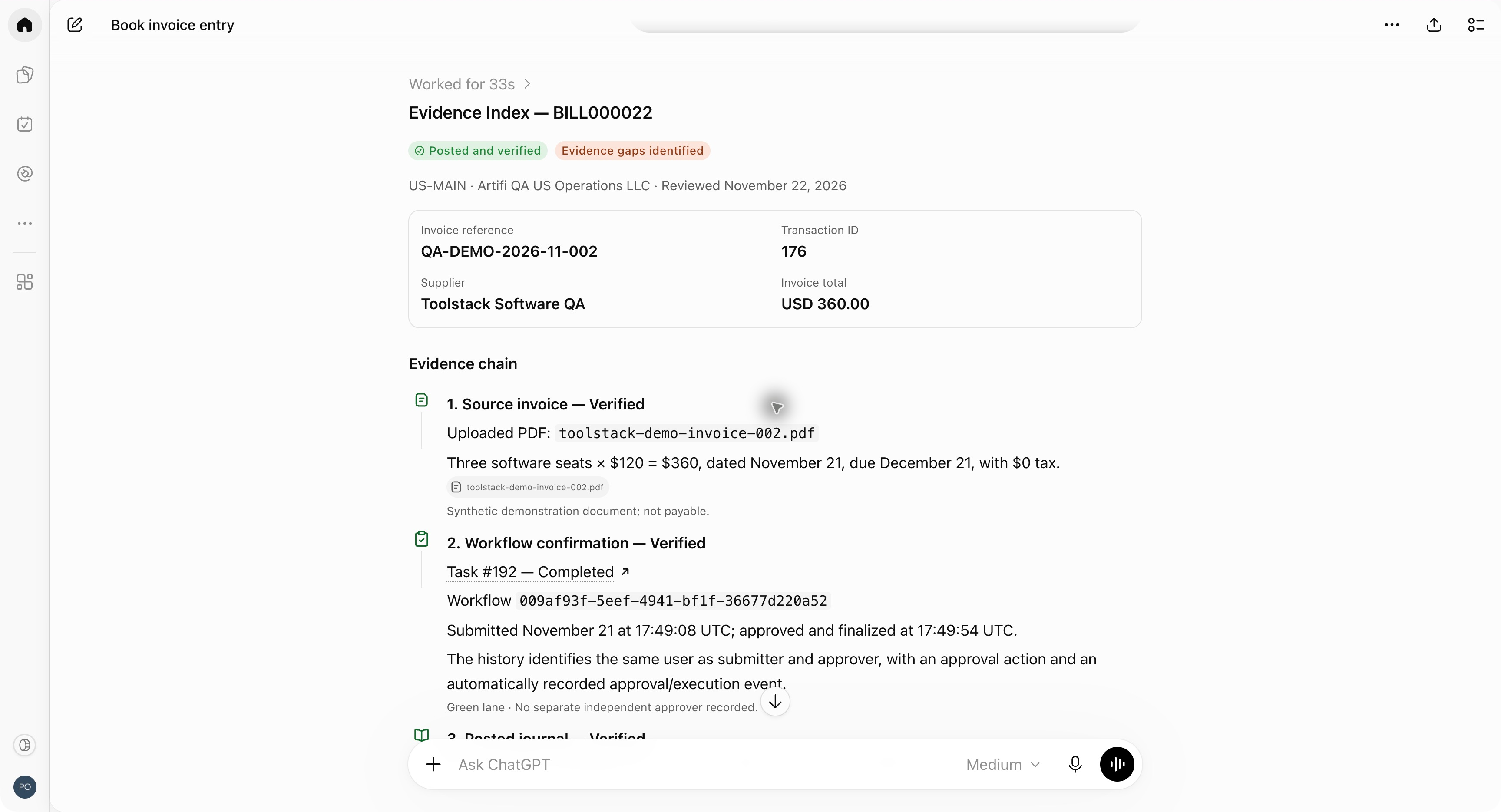
Build an evidence index for BILL000022: source, confirmation, journal and balance. Flag gaps.
The actual response connected these records:
| Evidence item | What the check established | What that means for the reviewer |
|---|---|---|
| Original invoice PDF | Three seats × $120 = $360; dated 21 November, due 21 December | Initially only in chat; subsequently stored against the bill and read back |
| Completed review task | Saved task 192 records submission and confirmation on 21 November | Same-person confirmation under the configured workflow, not independent approval |
| Posted bill and journal | BILL000022; debit 6960 Software & Subscriptions $360, credit 2000 Accounts Payable $360 | The accounting effect is balanced and traceable to the saved bill |
| Bill balance | $0 paid; $360 remaining | Posting created an unpaid obligation, not a payment |
| Supplier balance | $600, including earlier BILL000021 for $240 | The new bill accounts for part of the supplier's total |
Repair the source link, then read the stored file
The first attachment-register search found no matching linked PDF. The saved source reference pointed to the ChatGPT submission. That exposed a practical handoff issue: a reviewer opening the bill later needed the original document, not just a conversation saying it had been used.
We attached the original PDF to the bill through Arfiti's supported attachment operation, outside ChatGPT. The file was stored successfully and its content was read back. This document repair did not change the journal or the amount owed.
We then asked ChatGPT:
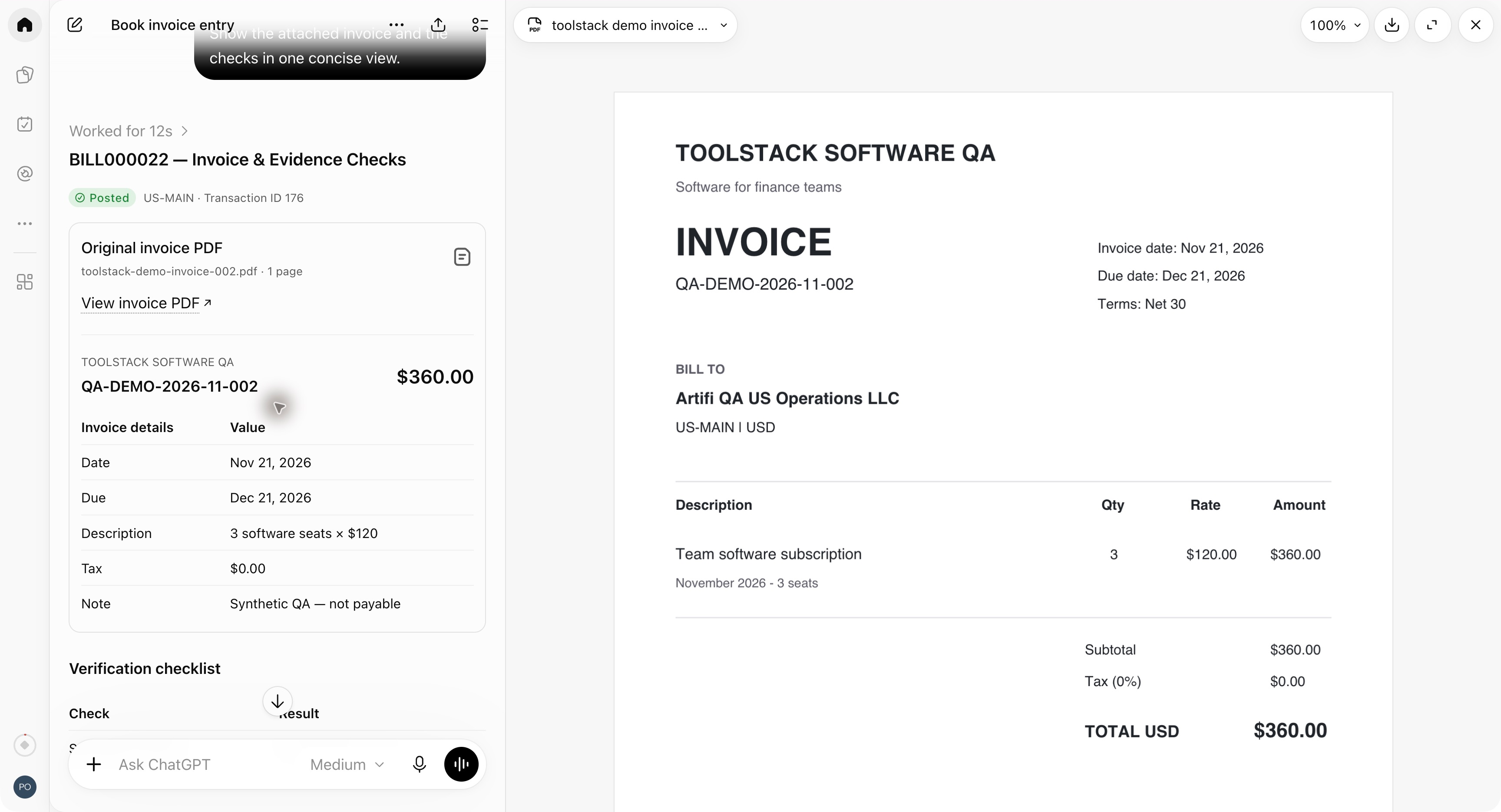
Recheck BILL000022’s stored invoice attachment and read it back.
Show the attached invoice and the checks in one concise view.
The response retrieved the stored attachment and showed the invoice alongside its checks: supplier, invoice reference, dates and three software seats at $120 each, totaling $360.
The verification also caught an error in ChatGPT's initial description of the file fingerprint. A follow-up calculation corrected that description, and we independently checked the stored file against the original. For an accountant, the lesson is practical: inspect the underlying evidence and challenge a questionable explanation. A confident response is still something to review.
The source-link gap is now resolved for this bill. That is a specific improvement to the evidence pack, not a claim that every possible audit requirement has been satisfied.
The response also noted same-person confirmation and empty dimension assignments. These need careful interpretation. Same-person confirmation was the chosen process for this demonstration; it is not a defect simply because it is not independent approval. Likewise, the check did not establish whether department or cost-center dimensions were required for this transaction. Empty fields alone do not establish a policy breach.
The invoice's zero tax was a synthetic fixture assumption. It should remain identified that way, rather than being presented as verified tax treatment for a real purchase. The index's value is precisely this separation: what the records support, what the configured process was, and what still requires evidence or policy context.
Ask ChatGPT to organize the request
Begin with the actual request list and the records you are permitted to share. A short prompt is enough when the company, period and scope are supplied:
Match these requests to the available evidence. List what is missing.
Ask for one row per request, with the source reference, relevant record or page, and the remaining question. Keep the auditor's request identifier so the returned package can be checked against the original list.
For a bill, the follow-up might ask for the original invoice, service evidence, coding rationale, recorded journal and confirmation history. Some requests need additional support; others are narrower. The scope comes from the engagement and the request, not from a universal checklist invented by the assistant.
Where ChatGPT cannot open a link or access a record, the index should say so. A filename that sounds relevant is not evidence that the contents answer the request. A link that works for the preparer may also be inaccessible to the intended recipient.
Explain the relationship between the figures
The supplier balance in our recording is a good example of a small reconciliation that improves a handoff:
Earlier unpaid bill $240 + new unpaid bill $360 = supplier amount due $600.
That explanation connects the individual document to the balance without implying that the new invoice created the whole liability. It also keeps the absence of a payment clear.
A useful follow-up prompt is:
Show how this bill ties to the journal and supplier balance.
Request the underlying bill references and amounts, rather than only a total. Verify the reporting date and whether credits, payments or reversals change the population. The recorded answer establishes the displayed example at that time; it does not prove every later balance or the completeness of all company payables.
If a report and a transaction disagree, preserve the difference in the working paper. Investigate dates, currency, filters and subsequent activity before replacing either number. The discrepancy can be the most useful part of the preparation.
Separate a clear explanation from audit assurance
The Accounting plugin can help assemble records and explanations. Whether that evidence is sufficient for an audit conclusion remains a matter for the applicable engagement and the auditor's work.
For example, PCAOB AS 1105 discusses evaluating the accuracy, completeness and appropriate detail of company-produced information when it is used as audit evidence. Those requirements apply in their own auditing context; producing a well-formatted table does not establish that they have been met. PCAOB AS 1105, paragraph .10
Similarly, a same-person confirmation in our demo is not evidence of independent second-person approval. If a company's control requires a separate approver, the evidence must identify that control and who performed it. We should describe the demonstrated workflow as it happened.
This leaves room for useful AI assistance without blurring the result. The accountant gets a better organized starting point, with gaps they can resolve before the package reaches the reviewer.
Prepare the handoff so someone else can use it
Before sharing, open the references, confirm the intended recipients' access and check that the package contains only the authorized entity and period. Preserve originals and identify any annotated or derived copies. Keep the preparer's explanations distinct from source documents.
A final request can be:
Summarize what is supported, what is unresolved and who needs to follow up.
The answer should name specific items: a missing service confirmation, an inaccessible invoice or a balance that needs a dated rerun. Avoid broad labels such as “audit-ready” when those checks remain open.
In our Arfiti example, the original PDF is now stored against the bill and has been read back. The next step is to confirm any engagement-specific support, recipient access and applicable dimension requirements. The document repair did not alter the posted accounting; the read-only ChatGPT recheck verified the result.
Discuss an evidence-preparation workflow with Arfiti if you want to explore how your source documents, accounting records and review process could fit together. Start with one request and one transaction; judge the output by how easily another person can trace the explanation.