Explain budget variances with ChatGPT Accounting
Turn a variance table into a conversation about what changed, which explanations hold up and what the business should investigate.
“Software is $3,000 over budget” repeats the report. The finance team still needs to explain whether the business bought more seats, paid a higher rate, changed products or recorded something in the wrong month.
ChatGPT Accounting can help prepare that investigation. Give it a defined budget, comparable actuals and supporting records, then ask it to separate calculations from explanations. The useful output is commentary that a finance manager can challenge and a department owner can act on.
OpenAI explicitly includes budget variance work in its Accounting plugin examples. We ran the example below in ChatGPT with Accounting selected, using a clearly labeled synthetic CSV. The figures are invented scenario data, not a budget or actuals retrieved from Arfiti. The screenshots show the real analysis of that file.
Agree what the comparison means
A variance begins with two numbers, but those numbers need a shared basis. November actuals through the twenty-first are not directly comparable with a full November budget. A revised forecast answers a different question from the original approved plan. A department export can omit shared costs that appear in the management report.
Before asking for explanations, specify the legal entity, period, currency, budget version and expense scope. Say whether actuals are preliminary or closed and whether allocations and accruals are included. Have ChatGPT show this basis at the top of the workpaper.
A useful first prompt is:
Explain the variances in this synthetic budget file.
Supply the approved version and the actuals, rather than asking the assistant to guess which file is current. If the required budget is unavailable, the right next deliverable is a missing-source list. Last year's actuals or a forecast may be useful comparisons, but should retain their own labels.
Arfiti's budget records distinguish versions and reporting periods. The reporting basis still matters: a period-to-date request and a completed-period total can produce different answers. Ask for the period rows and reporting cutoff when totals look unexpectedly empty or incomplete.
Start with a table that ties out
Our file represents a fictional full-month November scenario for US-MAIN in USD, with comparable expense categories and a fictional approved-budget version. November was still in progress when we tested it on November 22; these are not closed-month results. Positive variance means actual expense exceeds budget.
| Expense | Budget | Actual | Actual minus budget |
|---|---|---|---|
| Software | $10,000 | $13,000 | +$3,000 |
| Travel | $6,000 | $4,000 | −$2,000 |
| Contractors | $8,000 | $10,000 | +$2,000 |
| Total | $24,000 | $27,000 | +$3,000 |
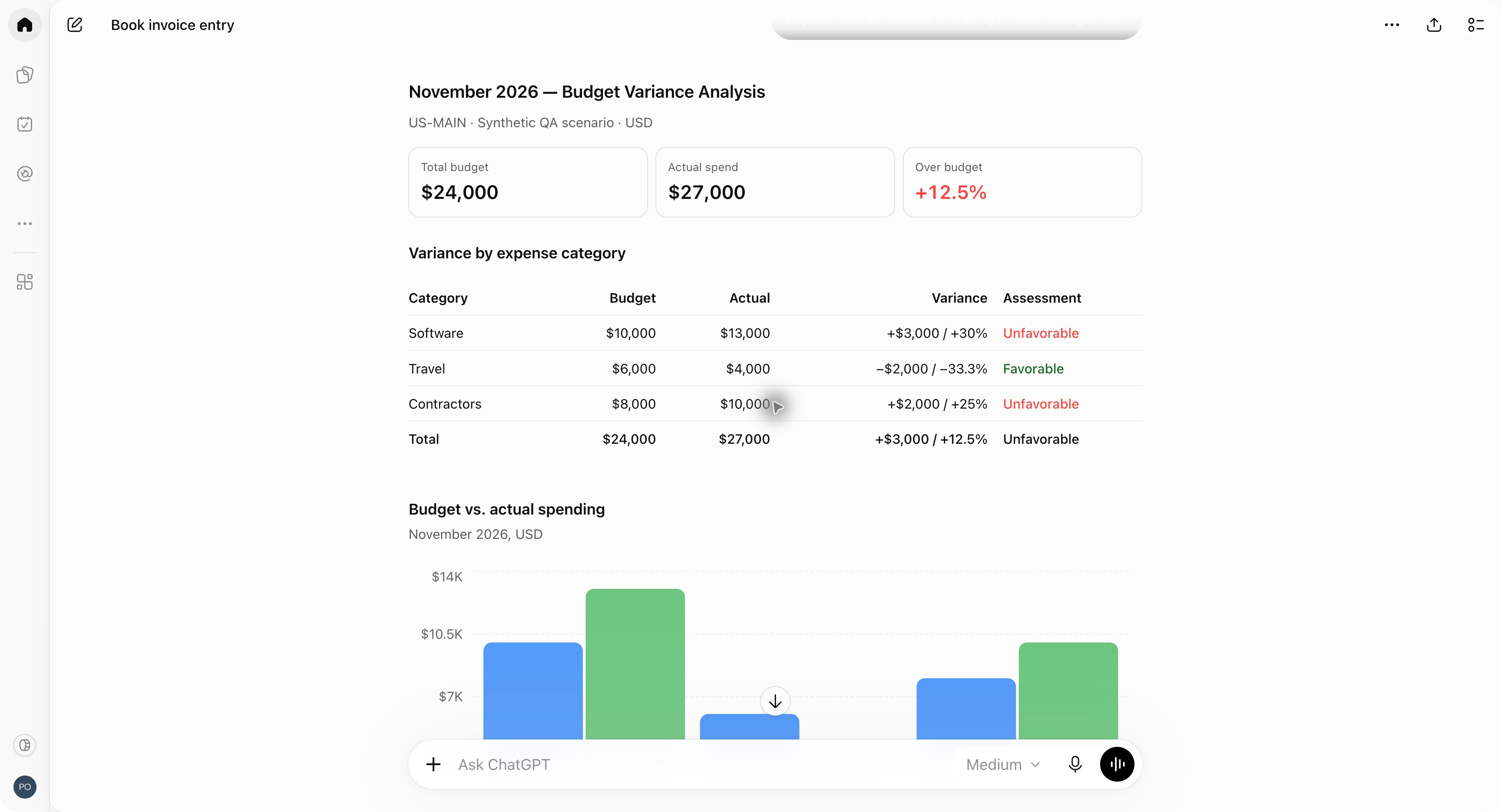
The total is $3,000 over budget. Software and contractors contribute $5,000 of excess expense, partly offset by $2,000 lower travel expense. Showing the components prevents a net total from hiding the size of the movements beneath it.
Ask ChatGPT to reconcile the actuals to the chosen source report before drafting commentary. Check whether each ledger account maps to one category, whether any records were omitted and whether credits have the correct sign. Keep an unmapped category visible until it is resolved.
For percentages, make the denominator explicit. Software's $3,000 variance is 30% of its $10,000 budget. Where the budget is zero, a conventional percentage variance is undefined; report the amount and investigate the unbudgeted activity instead.
Turn a large variance into a testable explanation
The next prompt can stay simple:
What explains the software variance? Show the evidence.
The synthetic CSV supplies 200 seats at $50 for budget and 250 seats at $52 for scenario actuals. No supplier invoice was uploaded for this test. Those input assumptions let us check the arithmetic; a real investigation would also need the invoice and subscription records.
One explicit calculation separates the $3,000 difference:
| Driver | Calculation | Effect |
|---|---|---|
| More seats, valued at the budget rate | (250 − 200) × $50 | $2,500 |
| Higher rate, applied to actual seats | 250 × ($52 − $50) | $500 |
| Total difference | $13,000 − $10,000 | $3,000 |
This method assigns the combined volume-and-rate effect to the rate component by using actual seats there. State the method so the reviewer can reproduce it; other decomposition conventions can allocate that interaction differently.
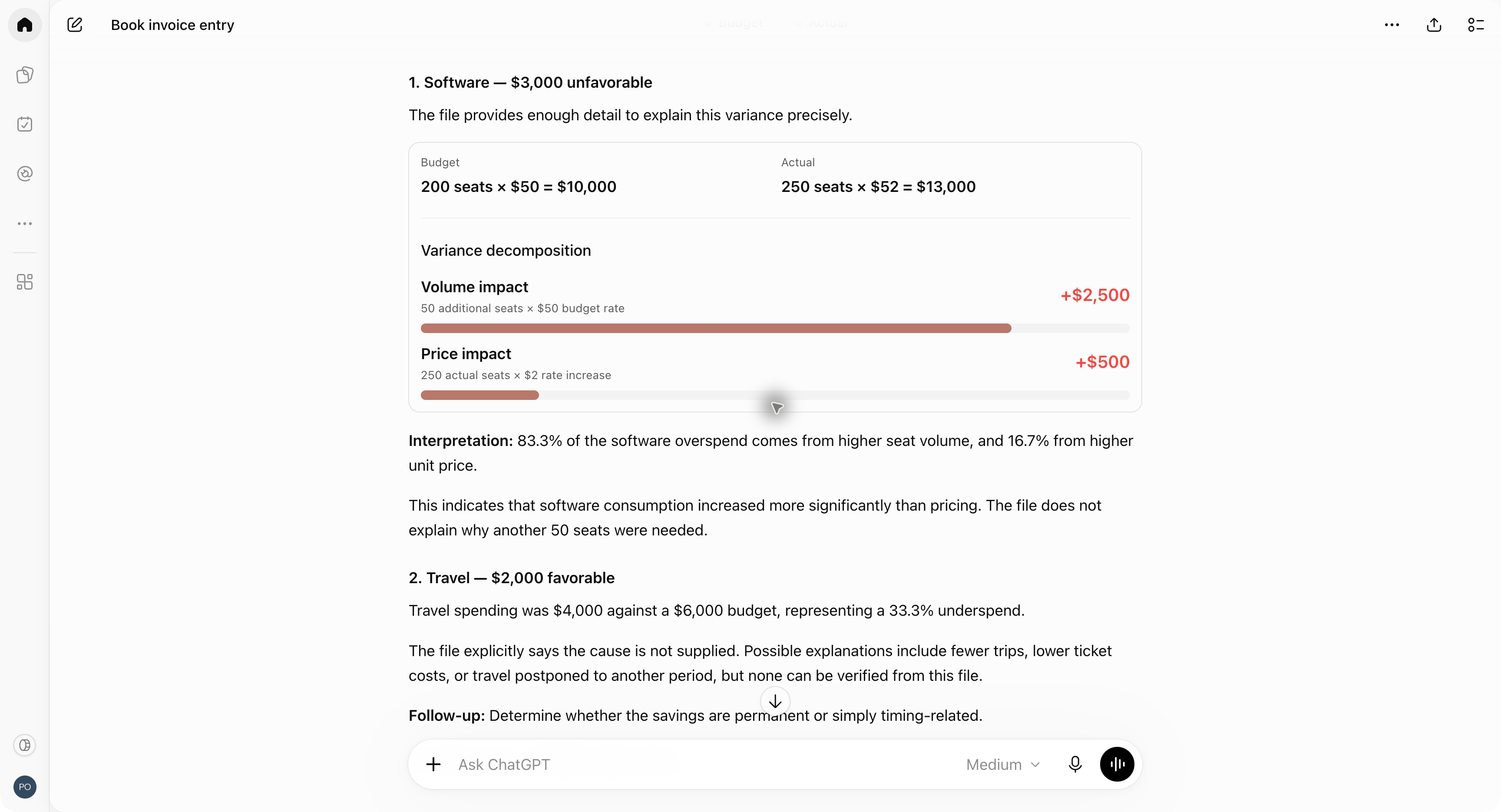
The arithmetic explains the supplied scenario's change. It does not yet explain the business decision. The extra seats might support new hires, temporary staff or unused licenses. Ask for the subscription roster, approved purchase change or department explanation before turning any of those possibilities into a conclusion.
Keep supported causes separate from open questions
Useful commentary names its source and its remaining uncertainty. A source-faithful version of the commentary is:
Software expense exceeds budget by $3,000. The supplied synthetic CSV assumes 250 seats at $52, compared with the budget's 200 seats at $50. Using the stated decomposition, seat volume accounts for $2,500 and the rate change for $500. We have not yet confirmed who uses the additional seats.
That gives the department owner a precise question. “Software overspend reflects rapid growth” would require evidence of growth and its relationship to those purchases.
The same discipline improves the travel discussion. A $2,000 favorable variance could reflect fewer trips, delayed invoices, a canceled event or an incomplete accrual. Calling it a saving before checking those alternatives can mislead the forecast.
For contractors, inspect the engagement period and work delivered. A project milestone may explain a legitimate timing difference. An annual prepayment coded entirely to one month raises a different accounting question. ChatGPT can help organize those questions around the relevant lines instead of creating one plausible story for every unfavorable number.
Shape the commentary around a decision
Once the sources support an explanation, ask:
Draft the management commentary. Separate decisions from follow-up questions.
A manager may need to review seat assignments, update the forecast for an approved headcount change or ask a supplier about a new rate. The action should follow from the evidence. A rate increase supported by a renewed contract may belong in the forecast; an unexplained invoice line may need investigation first.
Keep the original budget unchanged during this analysis. Revising the forecast, changing the approved budget and correcting a ledger entry are separate actions with different owners and controls. An explanation in a report does not authorize any of them.
OpenAI's budget-versus-actuals guidance also emphasizes category mapping, reconciliation and supported explanations. A workbook can preserve the source figures and formulas while a concise narrative carries the findings into the management meeting.
What this run established
ChatGPT reproduced the $24,000 and $27,000 totals, the $3,000 net variance and the $2,500/$500 software decomposition. It left travel and contractor causes unresolved because the file did not supply them. Its response also distinguished the scenario from the live Arfiti P&L, which showed $600 of posted expenses in our separate check. No budget, forecast or ledger record changed.
For the accountant, the useful result is a calculation that ties out and a short list of evidence to obtain. This test demonstrates file-based analysis; live budget retrieval and ledger-to-budget mapping remain a separate verification step.
Make next month's review easier to repeat
Keep the agreed account mapping, sign convention and report layout with the reviewed workpaper. On the next run, supply the new actuals and verify the budget version again. Reuse the structure while checking whether the explanations still apply.
This is a practical role for the Accounting plugin: help the preparer assemble the calculations and questions that make a financial conversation useful. The accountant can then assess the evidence, challenge the causes and discuss a response with the business.
Start with one department and one completed month. Ask whether the resulting explanation points to something the budget owner can verify or decide. Talk to Arfiti about your reporting workflow if you want to explore a connected version using your accounting records.