How finance teams can use the ChatGPT Accounting plugin
A practical way to organize accounting questions, review evidence and move selected work through a connected accounting system.
A finance team's day often begins with a set of questions: what needs attention, which records explain it, and what can we do next? The ChatGPT Accounting plugin offers a conversational way to work through those questions using files and connected accounting systems.
A useful first application is a focused review of supplier invoices. Ask which bills are due, inspect the records behind the answer, and choose the next action. The same structure can support transaction reviews, reporting questions and preparation for close.
We tested a focused daily review in ChatGPT with Accounting selected and Arfiti QA US connected. The synthetic company had two open supplier bills and no pending approvals. The wider team workflow below builds on that check; it is not a customer case study.
What the live worklist showed
What needs my attention today in US-MAIN?
On November 22, the response identified $600 of open payables, no overdue payables and no pending tasks in the queues checked. BILL000021 for $240 and BILL000022 for $360 were both due December 21. The AP subledger and control account each showed $600, with no difference.
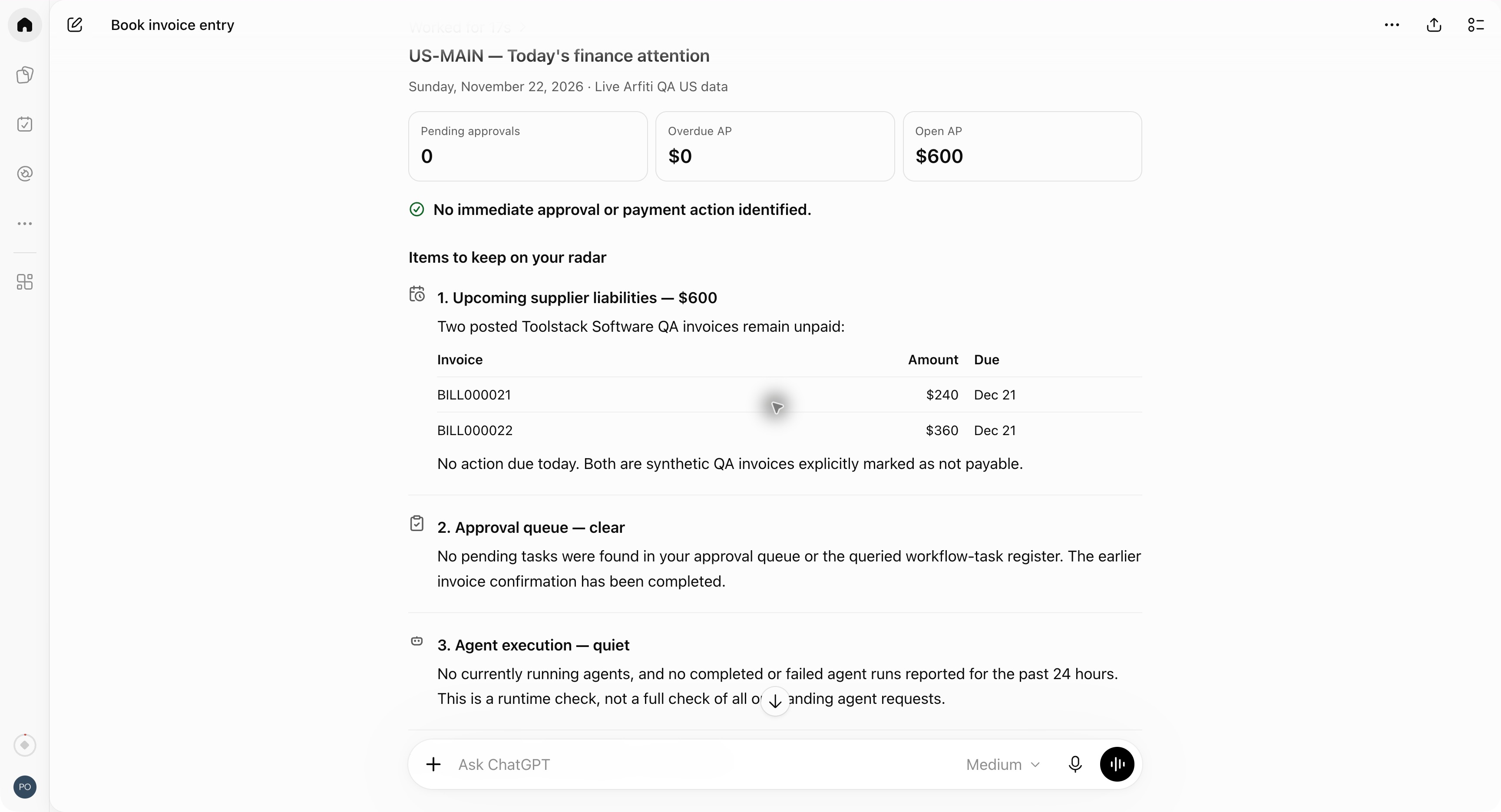
The useful exception was a reporting configuration question: the AP report flagged an unconfirmed default timezone. ChatGPT also explained that its agent check covered recent runtime activity, not every outstanding request. This was a focused read-only check, not a comprehensive finance audit. Both bills are synthetic and explicitly not payable.
For an accountant, that distinction makes the handover useful: upcoming obligations, an identified configuration follow-up and the boundaries of the review, all in one place.
Give the conversation a defined accounting job
“Review our finances” leaves too much open. A review of one company's supplier invoices due next week has an identifiable scope and an output that someone can check.
Before starting, establish the company, the period or as-of date, the reporting currency and the person responsible for acting on the findings. These are ordinary accounting requirements. They also make a conversational answer easier to evaluate.
For example, an accounts payable accountant could ask for a due-invoice worklist. A controller could inspect the larger items or unusual balances. The person responsible for cash planning could use the verified obligations as one input to a payment discussion. Each person needs the underlying records as well as a summary.
OpenAI describes Accounting as a plugin with an Accounting skill and app connections. The skill supplies guidance for the work; the connected system supplies records and available actions. Access depends on the workspace, connection and permissions. OpenAI Accounting
1. Start with what needs attention
After confirming the intended company and date range, try a short question:
Which supplier invoices are due next week?
Ask the answer to include supplier, invoice reference, due date, currency and remaining amount. Define “next week” with exact dates if the period is ambiguous. For more than one currency, keep the amounts separate unless a stated conversion basis is available.
The purpose is to create a worklist. Its usefulness depends on completeness: whether it includes the intended entity, whether credits and payments affect the remaining amounts, and whether the date filter is correct. A list of original invoice totals can differ from the amounts still owed.
Check an item against its source before using the list for planning. If the assistant cannot retrieve a needed field or part of the ledger, ask it to identify the gap. You can then decide whether to obtain another report or narrow the task.
2. Follow the answer back to the records
A good summary helps the team decide where to look. The next question should expose the evidence:
Show me the bills behind that total.
The installed Accounting skill instructs the assistant to support aggregates with granular records and cite the sources it uses. That is particularly useful when several people need to discuss the same number. A controller can inspect the bills, rather than asking the first person to reconstruct where a headline balance came from.
For an unexpected balance, ask what changed and inspect representative transactions. Distinguish an unusual item from an error. A large annual subscription may be expected; an entry with a surprising account may follow the company's documented policy. The skill calls for checking policy before presenting an issue as a mistake.
A useful finding names the record, explains its effect and identifies what is needed to resolve it. “This balance looks high” is the start of an investigation. It does not yet justify changing the books.
3. Turn one finding into a specific proposal
Choose a bounded action after the review. An unrecorded supplier invoice is a practical example:
Book this invoice.
In our separate synthetic demonstration, this prompt accompanied a $360 software invoice. ChatGPT prepared an entry and returned a task awaiting confirmation. The configured workflow required the same person to review the proposal before it could post.
The person then said:
Looks good, confirm it.
The result was a posted $360 bill. A subsequent supplier query returned $600 outstanding, made up of an earlier $240 bill and the new $360 bill. That recorded example shows how a follow-up question can connect a completed posting to the supplier account.
For a team, the review point is where responsibility becomes concrete. Someone checks the document, company, dates, tax treatment and accounts. This particular demonstration used same-person confirmation. If your process requires an independent reviewer, configure and verify that separate approval path before relying on it. Booking a supplier bill does not pay it.
4. Verify the result before reporting completion
A proposed change and a saved result answer different questions. After an approved action, ask to retrieve the record:
Show me the posted entry.
Compare the saved amount, accounts and source reference with what was approved. For a follow-up balance, ask for its constituent records again. This closes the loop between the question that started the work and the accounting state after the action.
If a response stops midway or its status is uncertain, inspect the existing task and transaction before repeating the action. OpenAI's accounting guidance recommends checking the system of record when an action's outcome is unclear. Using ChatGPT for accounting work
The team can then distinguish work completed, work waiting for review and questions that still need evidence. A useful handover includes the record references and the reason an item remains open.
Apply the same structure to other finance questions
The pattern also fits a reporting question: choose the period, retrieve the report, ask which transactions explain a movement, and document the interpretation. Keep the comparison basis consistent. A partial month and a full prior month need context before their difference becomes a business conclusion.
For reconciliation, establish both sides of the comparison and ask for unmatched items. The Accounting skill highlights complications such as partial payments, fees, credits and timing differences. Those instructions help frame the investigation; a suggested match still needs supporting records and a supported action before it becomes a saved reconciliation.
For close preparation, ask for a defined check and a record-backed exception list. Your close policy determines which findings require action and who signs them off. Access to an accounting plugin does not set your materiality policy or remove the need for judgment.
Start with one repeatable team question
Choose a question your team already asks regularly and whose answer you can verify. Supplier invoices due in a defined week are a reasonable starting point. Establish the source records, agree what a complete answer includes, and decide who owns the next action.
Use the first session to judge the quality of the evidence and the clarity of the review. That provides a more useful basis for expanding the workflow than assuming a broad productivity benefit before trying it.
Request a connected Arfiti walkthrough and tell us which accounting question your team wants to handle in ChatGPT. We can start with that process and identify the records, connection and review rules it needs.